

AI is changing how enterprises consume cloud resources. As CPTO, how do you see product innovation evolving beyond cost optimization to help businesses make smarter technology decisions?
The next phase of cloud and AI innovation is about moving from cost visibility to decision intelligence. Cost optimization remains important, but businesses increasingly need to understand the relationship between technology consumption, performance, business outcomes, and growth.
Organizations need visibility into what they are spending, why they are spending it, and what actions will have the greatest business impact. With AI workloads, this becomes even more important because costs can change rapidly based on model selection, inference volume, usage patterns, and the cloud infrastructure supporting those workloads.
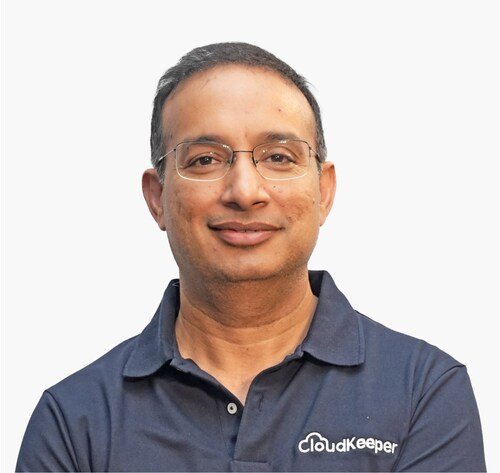
Sanjeev Mittal, CPTO, CloudKeeper
Product innovation therefore needs to bring together financial, operational, and engineering intelligence. For CloudKeeper, the goal is to help them determine whether they are using the right architecture, infrastructure, model, or consumption strategy and what decision will deliver the best outcome.
I believe the products that win will be those that translate complex technical data into clear, actionable decisions while keeping humans firmly in control of the most important choices.
You’ve led teams across startups, global enterprises, and high-growth SaaS companies. What leadership principle has remained constant throughout your journey?
The principle that has remained constant is to give people context, ownership, and trust.
People perform at their best when they understand what they are being asked to do and why it matters. Once the objective is clear, I believe leaders should give teams enough ownership to figure out the best way to achieve it.
This becomes particularly important in technology organizations, where the answers are rarely obvious. Product, engineering, sales, and customer teams need to work together, challenge assumptions, and learn quickly. A leader’s role is to create an environment where the team can find better answers faster.
I’ve also learned that speed and accountability go together. High-growth environments require people to make decisions with imperfect information. You cannot eliminate uncertainty, but you can build a culture where teams take ownership of decisions, learn from outcomes, and continuously improve.
Cloud optimization often involves technical complexity. How do you ensure customers experience simplicity without sacrificing powerful capabilities?
I think of this as hiding complexity without eliminating capability.
Cloud environments are inherently complex. Customers may have hundreds of accounts, thousands of resources, multiple cloud providers, Kubernetes environments, commitments, usage patterns, and increasing AI workloads.
A product that exposes all that complexity to the user may simply be giving them more work.
Our approach is to build intelligence underneath the experience and make the outcome simple. For example, CloudKeeper’s platforms bring together billing and usage data, resource information, commitments, optimization opportunities, and business context so customers can move from raw cloud data to actionable insights.
The interface should answer questions such as: Where am I spending? Why is it happening? What can I optimize? What should I prioritize? What will the impact be?
At the same time, sophisticated users should be able to drill down into the underlying data when they need it. That balance – simple by default, powerful underneath – is fundamental to how I think about product design.
With rapid advancements in AI and cloud technologies, what skills do you believe tomorrow’s product and engineering teams need to develop today?
The most important skill will be the ability to learn continuously and work across disciplines.
The boundaries between product, engineering, data, cloud infrastructure, security, and business are becoming increasingly blurred. Product managers need to understand technology more deeply, engineers need stronger business context, and both need to understand how AI is changing the way products are built and consumed.
I would highlight three capabilities in particular: AI fluency, systems thinking, and business understanding.
AI fluency doesn’t mean everyone needs to become an ML engineer. It means teams should understand how models work, where they add value, their limitations, and the economics behind deploying them at scale.
Systems thinking is equally important because optimizing one component of a cloud environment can sometimes create inefficiencies elsewhere. Teams need to understand the relationships between applications, infrastructure, data, AI workloads, and business outcomes.
Finally, people need stronger commercial awareness. Technology decisions increasingly have direct implications for margins, customer experience, scalability, and growth. The best teams will be those that can connect a technical decision to a measurable business outcome.
Looking ahead five years, what major shift do you believe will redefine enterprise cloud strategies?
I believe enterprise cloud strategy will shift from infrastructure-centric thinking to outcome-centric technology economics.
For years, organizations focused heavily on migration, infrastructure modernization, and utilization. The next five years will require a much broader view.
Enterprises will need to understand the economics of every technology decision – from cloud infrastructure and Kubernetes to AI models, inference, data, and the applications built on top of them.
AI will accelerate this move. This will bring engineering, product, finance, and business teams much closer together. FinOps will increasingly evolve into a broader discipline of technology economics, where organizations continuously measure, optimize, and align technology consumption with business outcomes.
The companies that succeed will not be those that spend the least on technology. They will be the ones that get the most business value from every dollar they invest in technology.
Enjoyed this interview? Now imagine yours. Write to:
jeevika@thefoundermedia.in
About The Author