

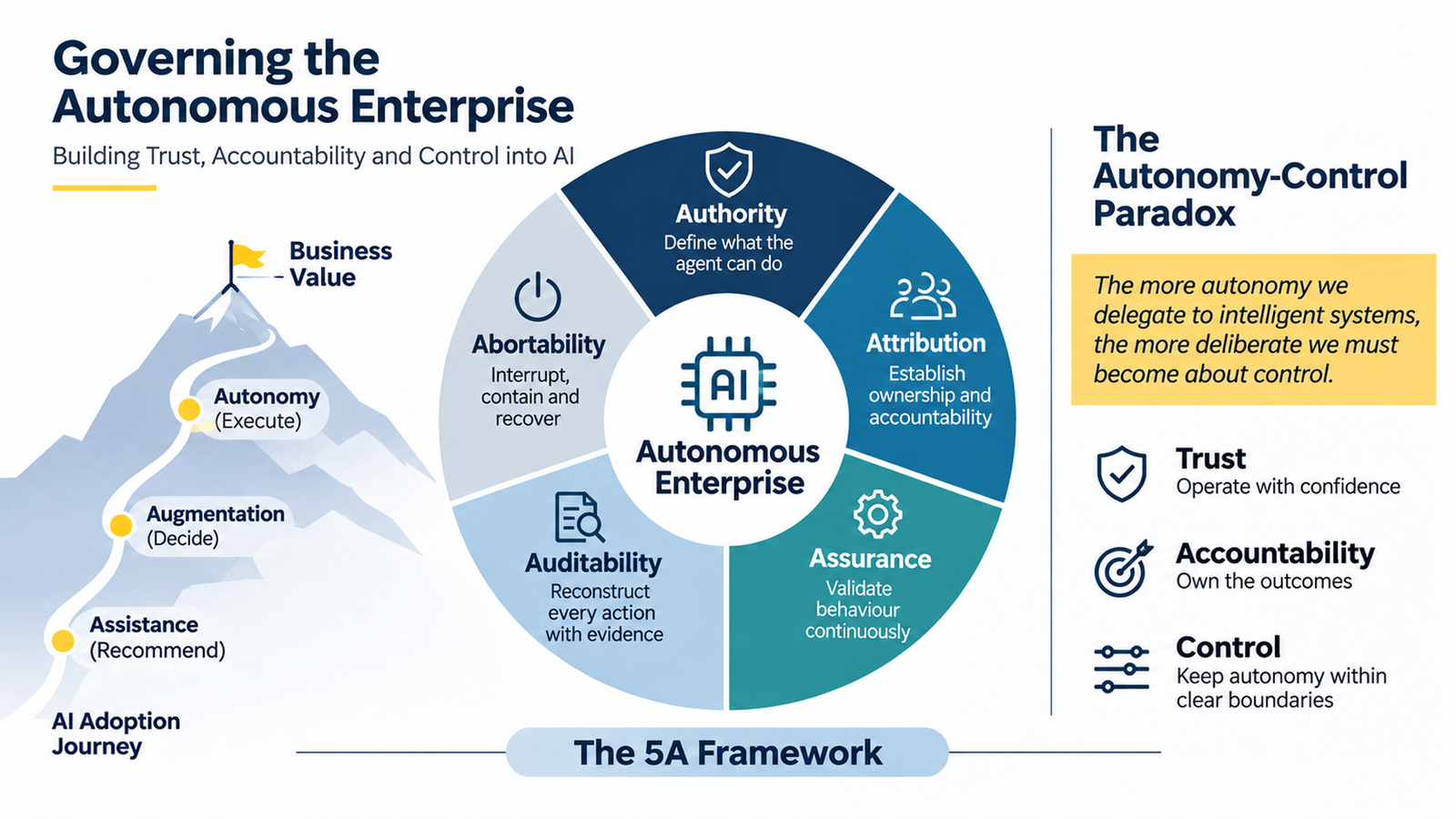
The autonomy-control paradox
As autonomy increases, control cannot be reduced to a policy document or a human approval checkbox. An agent may interpret instructions, retrieve untrusted information, call APIs and chain actions before a person sees the outcome. Prompt injection, tool misuse, excessive permissions, compromised credentials, data leakage and unintended downstream actions become operational risks, not theoretical model concerns.

Araveinth Gopinath, Group CISO & Head of IT, Yubi
The market is already signaling this gap. EY’s September 2026 survey of 202 US senior AI executives at large companies reported that 91 per cent had agentic AI in pilots or deployment, while 49 per cent of agentic AI users said their governance framework had not been specifically updated for agentic AI. EY also reported that 26 per cent of those users could not detect unauthorized agents internally. These are survey findings, not universal measures, but they illustrate a familiar enterprise problem: adoption can move faster than control maturity.
Security must follow the agent
AI agents should be treated as non-human identities with explicit owners, lifecycle management and narrowly scoped permissions. Shared credentials and broad service access are difficult to reconcile with accountable autonomy. Permissions should be purpose-bound, time-limited where practical, and constrained to the specific tools, data and actions required for a task.
That means securing the full execution path, not only the model. Protect agent instructions and context; validate tool inputs and outputs; control API access; segregate sensitive data; monitor behaviour at runtime; and test for prompt injection, privilege escalation and abuse of connected tools. Third-party agents, plugins, models and integrations must be included in the enterprise threat model. If an agent can move money, change customer records, modify production systems or trigger material decisions, risk-based limits and human confirmation should be built into that workflow.
Design controls around consequence
Controls should be proportionate to the consequence of an action, not just the sophistication of the model. Reading a public document is different from retrieving regulated customer data; drafting a payment instruction is different from submitting it. High-impact operations should require step-up approval, independent checks, transaction caps, separation of duties or a second control path. Agents should not be able to approve their own exceptions, expand their own permissions or silently delegate beyond the original mandate. Where actions cannot be reversed, prevention and pre-execution validation become especially important.
A proposed governance lens: the 5A
Rather than presenting five principles as a new standard, I use them as a practical lens for translating established governance and security disciplines into delegated enterprise authority.
Authority defines the agent’s purpose, permitted actions, boundaries, approval conditions and escalation thresholds. Attribution connects every action to the agent identity, accountable human owner, initiating context and relevant tools or data. Assurance is continuous: validate behaviour, permissions, outcomes and control effectiveness, not just at pre-deployment review. Auditability preserves evidence sufficient to reconstruct what happened, why, under which authority and with what impact. Abortability provides a tested ability to stop execution, revoke credentials, halt downstream delegation, contain impact and recover or compensate where reversal is possible.
These dimensions must reinforce one another. A kill switch without visibility may stop the wrong process; logging without clear identity may not establish accountability; approvals without runtime enforcement can become ceremonial. The test is whether governance works during execution.
From compliance to operational resilience
Board oversight should focus on consequential autonomy: which agents exist, what authority they hold, what systems and data they can access, what risk they create, and whether controls have been tested under realistic failure conditions. Security teams should partner with product, technology, operations, privacy, legal and business owners. Agent inventories, threat models, red-team exercises, transaction thresholds, monitoring alerts, incident playbooks and recovery tests need to become part of normal operational discipline.
The goal is not to eliminate autonomy. Over-restricting agents can suppress value; under-controlling them can create invisible pathways through the enterprise. The right level of autonomy should be earned through evidence: measured reliability, bounded permissions, independent validation, meaningful human intervention and clear accountability.
Governance also needs a feedback loop: incidents, near misses, policy exceptions and emerging attack techniques should update risk ratings, controls and deployment decisions. The operating model must evolve with the agent ecosystem, not remain fixed at approval.
Trust will not come from declaring AI responsible or placing a human nominally in the loop. It will come from demonstrating that the enterprise can understand, constrain, attribute, monitor and interrupt autonomous activity.
The measure of an autonomous enterprise will not be how much authority it gives AI, but how confidently it can explain, constrain, account for and stop what AI is empowered to do.
Share your exclusive thoughts to:
jeevika@thefoundermedia.in
About The Author